Stephen Colbert Gives a Commencement Speech
In the middle it gets a little sarcastic and satirical, Stephen Colbert the character rather than Stephen Colbert the guy. Straight funny, good stuff. But at the beginning and the end it's quite beautiful.
Tuesday, May 30, 2006
Lovelines I Like
I was just griping to ToastyKen about how much I can't stand LoveLine, the nationally syndicated call-in question-and-answer show about sex and relationships that's aimed at teenagers. It's gotten all kinds of press for being an effective educational tool, but it strikes me as puerile prank caller heaven, and I just can't see how it helps anyone. That's not what really bothers me about it. What bothers me is that it's on at 10 pm, Sundays through Thursdays, on my main radio station KITS Live 105.3. This is particularly frustrating on the rare times I have to drive on a Sunday night--at least, I think, I can catch SoundCheck, but no! It quickly gets supplanted by the boring LoveLine. I mean, when more do you need to rock out then when you're stuck driving after 10? This is my grudge against LoveLine.
On the other hand Ruchira just sent me a much more elegant Lovelines--a blogscraper that displays recently blogged lines of the form "i love --." Sarcasm, affection, triviality, passion, overenthusiasm--it's a taste test of the web's emotional spicing. Check it out but don't get hypnotized.
I was just griping to ToastyKen about how much I can't stand LoveLine, the nationally syndicated call-in question-and-answer show about sex and relationships that's aimed at teenagers. It's gotten all kinds of press for being an effective educational tool, but it strikes me as puerile prank caller heaven, and I just can't see how it helps anyone. That's not what really bothers me about it. What bothers me is that it's on at 10 pm, Sundays through Thursdays, on my main radio station KITS Live 105.3. This is particularly frustrating on the rare times I have to drive on a Sunday night--at least, I think, I can catch SoundCheck, but no! It quickly gets supplanted by the boring LoveLine. I mean, when more do you need to rock out then when you're stuck driving after 10? This is my grudge against LoveLine.
On the other hand Ruchira just sent me a much more elegant Lovelines--a blogscraper that displays recently blogged lines of the form "i love --." Sarcasm, affection, triviality, passion, overenthusiasm--it's a taste test of the web's emotional spicing. Check it out but don't get hypnotized.

How Did I Miss This?!
Authorities say two separate Pensacola teachers apparently made the big bucks by accepting $1 payoffs from students wanting to get out of gym class. Their names are Terence Braxton and Tamara Tootle. I think Ms. Tootle must have been destined to appear in an odd news segment at some point of her life.
You might think that my titular question was an allusion to missing a two-month-old news story. But what I am really confounded at missing is the opportunity to bribe my way out of physical education. Scrupulous child that I was, that would have been awfully tempting. As it is I somehow managed to dance my way out of most P.E. classes.
I actually kind of regret this. I have no fond memories of the enforced Friday mile of seventh grade, but it was regular, and I did eventually get better at it. I've griped often about how adults end up doing less math in real life than they ought to because they did less math in school, but in all honesty that is probably even more true with respect to exercise. How to do a good crunch or sit-up is useful information that you don't want to be looking up every single time you need it.
The P.E.-averse brainiac is a staple of popular culture--if memory serves, genius Kid's avoidance of P.E. was a crucial plot point in Class Act--and the stereotype is that such children are simply lazy. Well, okay, I'm a tad lazy. But like a lot of other kids who shied away from PE, I've since also really enjoyed rock climbing, hiking, dancing, swimming, martial arts and soccer. It's always struck me as a little bizarre that P.E. is made as boring and routine as possible for younger children, who will have no appreciation of the need to exercise. I'm convinced that the combination of opportunities to look stupid and be made fun of with deathly dullness infected me with needless aversions. Eventually there are going to be Kumons and Sylvan Learning centers for kids who need to get motivated to play ball. It's a business opportunity for someone, but apparently not Tootle & Braxton.
Authorities say two separate Pensacola teachers apparently made the big bucks by accepting $1 payoffs from students wanting to get out of gym class. Their names are Terence Braxton and Tamara Tootle. I think Ms. Tootle must have been destined to appear in an odd news segment at some point of her life.
You might think that my titular question was an allusion to missing a two-month-old news story. But what I am really confounded at missing is the opportunity to bribe my way out of physical education. Scrupulous child that I was, that would have been awfully tempting. As it is I somehow managed to dance my way out of most P.E. classes.
I actually kind of regret this. I have no fond memories of the enforced Friday mile of seventh grade, but it was regular, and I did eventually get better at it. I've griped often about how adults end up doing less math in real life than they ought to because they did less math in school, but in all honesty that is probably even more true with respect to exercise. How to do a good crunch or sit-up is useful information that you don't want to be looking up every single time you need it.
The P.E.-averse brainiac is a staple of popular culture--if memory serves, genius Kid's avoidance of P.E. was a crucial plot point in Class Act--and the stereotype is that such children are simply lazy. Well, okay, I'm a tad lazy. But like a lot of other kids who shied away from PE, I've since also really enjoyed rock climbing, hiking, dancing, swimming, martial arts and soccer. It's always struck me as a little bizarre that P.E. is made as boring and routine as possible for younger children, who will have no appreciation of the need to exercise. I'm convinced that the combination of opportunities to look stupid and be made fun of with deathly dullness infected me with needless aversions. Eventually there are going to be Kumons and Sylvan Learning centers for kids who need to get motivated to play ball. It's a business opportunity for someone, but apparently not Tootle & Braxton.
Monday, May 29, 2006
Memorial Day
It's almost over, but I feel the need to observe it.* It has become the start of summer, a weekend of shopping, a day for barbecuing and sailing. It is supposed to be the day we remember the battlefield dead. Oddly enough, it doesn't seem to have acquired much more gravitas in the last 4 years when we actually have known battlefield dead again. Here's a little reminder:
Iraq: 2689 Total Coalition Deaths, 2456 Total U.S. Deaths.
Afghanistan: 378 Total Coalition Deaths, 296 Total U.S. Deaths.
Source: icasualties.org
It is my belief that any community of large enough size needs a trained and professional group of people, ideally volunteers, who are skilled in the use of force and able to be called on at a moment's notice to deal with that community's defense. It is an ancient lesson of warfare that such a group of people must have some measure of obedience "in the moment" and leave decisions about the wisdom of such a deployment to commanders. It is a fairly modern but brilliant assertion that a community wishing to rule itself, with some combination of democratic and republican ideals, should make such a group submit to the will of the community government as a whole--the civilian command. And so we have an Army and Navy and Air Force and Coast Guard and Marine Corps: people who volunteer and promise to fight and risk death when and where our government asks them to, and to be as obedient as possible. If you believe in the American system of government, and you believe that it is working, and you believe that when your government asks you to risk death and homicide, it must be doing so for the necessary defense of your community as you conceive of it, well then, this pledge of obedience is quite awe-inspiring. So as part of that community, I thank you for it. I may disagree with many of your beliefs, and try hard to dissuade you from them, but let us say, I appreciate the commitment.
Now another set of you may quibble with my basic, underlying belief. Assumptions have to start somewhere, and that is where I choose to start mine. I do not wish to quibble about it now, but to move on and make the next point. If we are going to send people to other lands to die (and more importantly, to kill) it is our duty to make absolutely certain that we understand what we are doing, that we know why we are doing it, and that we have thought and intelligently dismissed every single reason why we should not. The fact is, we do not do this. We citizens spend too little time considering our foreign policy, our military budget and organization, our treatment of veterans, our war crimes, and the repercussions of our opinions on war and peace and international trade. We spend too much time watching TV and shopping. We've been invading countries and overthrowing governments to please a fruit company here and a timber company there for well over a hundred years, spilling perfectly good American blood and, more horribly, staining its honor with the blood of innocent foreign civilians and foreign democracy. The best that can be said of most of us is that sometimes we take the trouble to recognize our absurdity and laugh darkly at our horror while watching the Daily Show, sometimes we take off a busy weekend to go protest an invasion, and sometimes we pat a traumatized soldier on the back.
It is my humble assertion that the best thing you can do to support the troops and honor the dead is carve out some time from your busy schedule to be a better citizen and pay attention to budgets and foreign affairs from an American perspective. It is not enough to know that there is civil unrest in a given country--one must also know how American companies are acting in that country, and what wealthy or otherwise influential Americans have a vested interest in that country, an interest they might be more than willing to let American troops risk dying and killing for. It is not enough to know that we are going to spend this or that percentage more on the defense budget--one must also know to whom we are handing over the money, and how much more they stand to make if someone decides their equipment and their help will be required for American troops risking death and homicide. And it is not enough to know these things, one must make noise if one does not like the way these things are going, if one might, just might, think they are a bad use of resources and perhaps, even, immoral. Make noise or something more forceful, but surely we should not be silent.
In the mean time please remember that the dead lie there in obedience to our command, even if we give it sleepily and by proxy.
*Especially since I actually went to work today.
It's almost over, but I feel the need to observe it.* It has become the start of summer, a weekend of shopping, a day for barbecuing and sailing. It is supposed to be the day we remember the battlefield dead. Oddly enough, it doesn't seem to have acquired much more gravitas in the last 4 years when we actually have known battlefield dead again. Here's a little reminder:
Iraq: 2689 Total Coalition Deaths, 2456 Total U.S. Deaths.
Afghanistan: 378 Total Coalition Deaths, 296 Total U.S. Deaths.
Source: icasualties.org
It is my belief that any community of large enough size needs a trained and professional group of people, ideally volunteers, who are skilled in the use of force and able to be called on at a moment's notice to deal with that community's defense. It is an ancient lesson of warfare that such a group of people must have some measure of obedience "in the moment" and leave decisions about the wisdom of such a deployment to commanders. It is a fairly modern but brilliant assertion that a community wishing to rule itself, with some combination of democratic and republican ideals, should make such a group submit to the will of the community government as a whole--the civilian command. And so we have an Army and Navy and Air Force and Coast Guard and Marine Corps: people who volunteer and promise to fight and risk death when and where our government asks them to, and to be as obedient as possible. If you believe in the American system of government, and you believe that it is working, and you believe that when your government asks you to risk death and homicide, it must be doing so for the necessary defense of your community as you conceive of it, well then, this pledge of obedience is quite awe-inspiring. So as part of that community, I thank you for it. I may disagree with many of your beliefs, and try hard to dissuade you from them, but let us say, I appreciate the commitment.
Now another set of you may quibble with my basic, underlying belief. Assumptions have to start somewhere, and that is where I choose to start mine. I do not wish to quibble about it now, but to move on and make the next point. If we are going to send people to other lands to die (and more importantly, to kill) it is our duty to make absolutely certain that we understand what we are doing, that we know why we are doing it, and that we have thought and intelligently dismissed every single reason why we should not. The fact is, we do not do this. We citizens spend too little time considering our foreign policy, our military budget and organization, our treatment of veterans, our war crimes, and the repercussions of our opinions on war and peace and international trade. We spend too much time watching TV and shopping. We've been invading countries and overthrowing governments to please a fruit company here and a timber company there for well over a hundred years, spilling perfectly good American blood and, more horribly, staining its honor with the blood of innocent foreign civilians and foreign democracy. The best that can be said of most of us is that sometimes we take the trouble to recognize our absurdity and laugh darkly at our horror while watching the Daily Show, sometimes we take off a busy weekend to go protest an invasion, and sometimes we pat a traumatized soldier on the back.
It is my humble assertion that the best thing you can do to support the troops and honor the dead is carve out some time from your busy schedule to be a better citizen and pay attention to budgets and foreign affairs from an American perspective. It is not enough to know that there is civil unrest in a given country--one must also know how American companies are acting in that country, and what wealthy or otherwise influential Americans have a vested interest in that country, an interest they might be more than willing to let American troops risk dying and killing for. It is not enough to know that we are going to spend this or that percentage more on the defense budget--one must also know to whom we are handing over the money, and how much more they stand to make if someone decides their equipment and their help will be required for American troops risking death and homicide. And it is not enough to know these things, one must make noise if one does not like the way these things are going, if one might, just might, think they are a bad use of resources and perhaps, even, immoral. Make noise or something more forceful, but surely we should not be silent.
In the mean time please remember that the dead lie there in obedience to our command, even if we give it sleepily and by proxy.
*Especially since I actually went to work today.
Thursday, May 11, 2006
SAVE CODY'S
I have just found out that Cody's Books on Telegraph is scheduled to close in two months and I am beyond distraught. I went there on my first day in Northern California, years and years ago, visiting with my parents. I can still remember the bright sight of flowers in front of a bookstore. I've probably bought the overwhelming majority of my books there, and certainly almost all of my non textbook hardcovers. Almost every author reading I've been to was there. I've discovered most of my favorite poets there. When I was in college I would, for the sake of grades, avoid bookstores for most of the semester. When I handed in my last final, I would run straight to Cody's, money in hand, and luxuriate there for the rest of the day, carefully choosing and stacking my vacation treasure. I can walk up to the customer service people and babble about some book, neither title nor author in hand, and 95% of the time, they'll find it. When we started bombing Iraq I curled up in a chair upstairs and listened to Pico Iyer's soothing voice and prayed. I really, really don't want to lose it.
If you have any ideas, please let me know. Seriously.
UPDATE: What the hell? Ruchira is telling me she's not seeing my level of alarm anywhere else. The Fourth Street store is staying open, so people are nonchalant. WHAT THE HELL? The Fourth Street store is great if you're looking for stuff on art or textiles, or want hand crafted paper. Fine. I met Oscar the Grouch there and that was cool. I got an education about Nantali Finland by a cashier once. But there is NO COMPARISON with Telegraph. Former Presidents and Senators aren't enticed to Fourth Street. You can't pack a room with people interested in science policy at Fourth Street. The Fourth Street store wasn't bombed for stocking Rushdie. Howl wasn't written across the street from the Fourth Street store. Dustin Hoffman didn't stop Elaine Robinson on the bus on Fourth Street! You can't buy music at late hours near Fourth Street, or sell records, or rummage through vintage clothes, or get the best damn feta-almond-spinach-fuji salad in California! You can't go to an author reading and then grab take out and eat dinner under the stars in a Redwood grove, or off in a plaza filled with vendors! IT's NOT THE SAME!
I mean, not to put too fine a point on it, but Fourth Street is Yuppie central. Now I probably qualify as something of a yuppie--though certainly not because of my wages--but that's the whole point. I don't NEED my whole universe to blandified into a well-designed set of tasteful, pleasant landscapes where everyone is just like me. Cody's on Telegraph is connected to the street. Cody's lets you loiter in the front and talk to people. Cody's lets street poets and homeless guys set up tables in front of the store. How many truly great bookstores--bookstores that great authors from all over the world carefully pen into their tour calendars--are so perfectly at the intersection of art, science, wealth, and poverty? I imagine there are some in Boston and NYC. I've always wanted to visit Powells--seriously, that's like the main reason I want to go to Portland. Well this is ours.
Update II: Non Berkeley-Friends who are trying be sympathetic and comforting have all kinds of sage observations about market forces and the nature of nostalgia. My initial reaction above reached into sentiment and nostalgia, but this is not a sentimental, nostalgic problem. It's not even about saving ambiance. This is a community disaster. Cody's Telegraph is one of a very small number of Bay Area bookstores that regularly hosts authors of new, cutting edge journalism, policy and science-writing. One knocked off the list will make the Bay Area one less plausible stop for a cash-strapped book tour, and non-trivially dents the chances that any given author will visit the area or spend a reasonable amount of time here. That means less opportunities to to be a guest on shows like KQED's Forum, less opportunities to be interviewed by local papers (and relate their writing to local issues), less reasons to speak at the Commonwealth Club or the World affairs Council. Less discussion. Less purchasing. Fewer books. Less journalism. Less democracy.
I really don't mean to dis the Fourth Street Store. I like it a lot and I've been to some very lovely literary readings there. I also like the new San Francisco store a lot. But you can't get to Fourth Street by BART, and San Francisco is very far away from a large portion of the Bay Area. Ten years ago I was a frequently broke, carless teenager who lived in Concord. Get rid of Cody's and you get rid of most of that teenager's opportunities to interact with the wide world of books and authors and adults who like to read about serious topics. I was lucky in that my parents are great lovers of books--if they wanted to treat me, they would take me to Cody's, and I'm sure if it had been necessary, they would have let me go to San Francisco. Not everyone is that lucky.
Cody's also anchors the street. Apparently Telegraph's increasingly unruly crowd is what's driving it out in the first place, but Cody's going will make the problem ten times worse. An abandoned Telegraph avenue is bad for the University--and I don't mean the dry institution that's often mismanaged by the regents, I mean the living community of people who work had to provide the best public higher education.
The owner, Andy Ross, doesn't seem to feel that this incarnation of the store can be saved, and I am sure he hasn't made this decision lightly. Right now I'm wondering about two options--can the store be moved to the Downtown Shattuck area, which has been experiencing a Rennaissance of book culture, and isn't quite as unruly? Or, can someone else buy the Telegraph store and keep it open?
The East Bay really should not lose its premier forum for the discussion of new writing, especially new nonfiction.
I have just found out that Cody's Books on Telegraph is scheduled to close in two months and I am beyond distraught. I went there on my first day in Northern California, years and years ago, visiting with my parents. I can still remember the bright sight of flowers in front of a bookstore. I've probably bought the overwhelming majority of my books there, and certainly almost all of my non textbook hardcovers. Almost every author reading I've been to was there. I've discovered most of my favorite poets there. When I was in college I would, for the sake of grades, avoid bookstores for most of the semester. When I handed in my last final, I would run straight to Cody's, money in hand, and luxuriate there for the rest of the day, carefully choosing and stacking my vacation treasure. I can walk up to the customer service people and babble about some book, neither title nor author in hand, and 95% of the time, they'll find it. When we started bombing Iraq I curled up in a chair upstairs and listened to Pico Iyer's soothing voice and prayed. I really, really don't want to lose it.
If you have any ideas, please let me know. Seriously.
UPDATE: What the hell? Ruchira is telling me she's not seeing my level of alarm anywhere else. The Fourth Street store is staying open, so people are nonchalant. WHAT THE HELL? The Fourth Street store is great if you're looking for stuff on art or textiles, or want hand crafted paper. Fine. I met Oscar the Grouch there and that was cool. I got an education about Nantali Finland by a cashier once. But there is NO COMPARISON with Telegraph. Former Presidents and Senators aren't enticed to Fourth Street. You can't pack a room with people interested in science policy at Fourth Street. The Fourth Street store wasn't bombed for stocking Rushdie. Howl wasn't written across the street from the Fourth Street store. Dustin Hoffman didn't stop Elaine Robinson on the bus on Fourth Street! You can't buy music at late hours near Fourth Street, or sell records, or rummage through vintage clothes, or get the best damn feta-almond-spinach-fuji salad in California! You can't go to an author reading and then grab take out and eat dinner under the stars in a Redwood grove, or off in a plaza filled with vendors! IT's NOT THE SAME!
I mean, not to put too fine a point on it, but Fourth Street is Yuppie central. Now I probably qualify as something of a yuppie--though certainly not because of my wages--but that's the whole point. I don't NEED my whole universe to blandified into a well-designed set of tasteful, pleasant landscapes where everyone is just like me. Cody's on Telegraph is connected to the street. Cody's lets you loiter in the front and talk to people. Cody's lets street poets and homeless guys set up tables in front of the store. How many truly great bookstores--bookstores that great authors from all over the world carefully pen into their tour calendars--are so perfectly at the intersection of art, science, wealth, and poverty? I imagine there are some in Boston and NYC. I've always wanted to visit Powells--seriously, that's like the main reason I want to go to Portland. Well this is ours.
Update II: Non Berkeley-Friends who are trying be sympathetic and comforting have all kinds of sage observations about market forces and the nature of nostalgia. My initial reaction above reached into sentiment and nostalgia, but this is not a sentimental, nostalgic problem. It's not even about saving ambiance. This is a community disaster. Cody's Telegraph is one of a very small number of Bay Area bookstores that regularly hosts authors of new, cutting edge journalism, policy and science-writing. One knocked off the list will make the Bay Area one less plausible stop for a cash-strapped book tour, and non-trivially dents the chances that any given author will visit the area or spend a reasonable amount of time here. That means less opportunities to to be a guest on shows like KQED's Forum, less opportunities to be interviewed by local papers (and relate their writing to local issues), less reasons to speak at the Commonwealth Club or the World affairs Council. Less discussion. Less purchasing. Fewer books. Less journalism. Less democracy.
I really don't mean to dis the Fourth Street Store. I like it a lot and I've been to some very lovely literary readings there. I also like the new San Francisco store a lot. But you can't get to Fourth Street by BART, and San Francisco is very far away from a large portion of the Bay Area. Ten years ago I was a frequently broke, carless teenager who lived in Concord. Get rid of Cody's and you get rid of most of that teenager's opportunities to interact with the wide world of books and authors and adults who like to read about serious topics. I was lucky in that my parents are great lovers of books--if they wanted to treat me, they would take me to Cody's, and I'm sure if it had been necessary, they would have let me go to San Francisco. Not everyone is that lucky.
Cody's also anchors the street. Apparently Telegraph's increasingly unruly crowd is what's driving it out in the first place, but Cody's going will make the problem ten times worse. An abandoned Telegraph avenue is bad for the University--and I don't mean the dry institution that's often mismanaged by the regents, I mean the living community of people who work had to provide the best public higher education.
The owner, Andy Ross, doesn't seem to feel that this incarnation of the store can be saved, and I am sure he hasn't made this decision lightly. Right now I'm wondering about two options--can the store be moved to the Downtown Shattuck area, which has been experiencing a Rennaissance of book culture, and isn't quite as unruly? Or, can someone else buy the Telegraph store and keep it open?
The East Bay really should not lose its premier forum for the discussion of new writing, especially new nonfiction.
Wednesday, May 10, 2006
National Priorities
The war in Iraq is more expensive than signing and abiding by the "prohibitively expensive" Kyoto Protocol would have been, according to Cass R. Sunstein of the University of Chicago, writing in the Washington Post.
The war in Iraq is more expensive than signing and abiding by the "prohibitively expensive" Kyoto Protocol would have been, according to Cass R. Sunstein of the University of Chicago, writing in the Washington Post.
Tuesday, May 09, 2006
Arbitrary Bastardization
Here's a little serious note about the American way of regarding other countries. Over at Slate's Today's Papers, Eric Umansky was discussing the coverage of Iranian President Ahmadinejad's unprecedented letter to President Bush and lack of seriousness with which the Administration read it. I haven't fully read the relevant stories, but the lack of seriousness seems not entirely unreasonable, at least in the abstract--the letter apparently rambles. (On the other hand, it seems distinctly less reasonable to deride and dismiss such an unusual overture so quickly and so publicly, even if the letter was totally nonsensical.) This passing line by Umansky caught my eye:
Something that a lot of Americans forget is that the Iranians actually have a democracy. It's a theocratic democracy that's missing a lot of what we would consider basic civil rights--it's not a Republic, let us say--but they do vote, and they do get to express their will a little bit. (And, interestingly enough, the women vote and the women even get elected, unlike the case with our dear friend Saudi Arabia.)And they voted for Khatami, and they voted for Ahmadinejad. It seems like a significantly more legitimate goverment than, say, the monarchy in Saudi Arabia, the dictatorships in Pakistan and Egypt, and the "Communist" party dictatorship in China--all governments that Bush deals with quite contentedly. In other words, we go around arbitrarily deciding whether or not a government is legitimate pretty much based on how we feel about it. It doesn't really matter what the facts are. It just matters what Bush's gut tells him. And that totally arbitrary bastardization matters more than anything--even more than solving our apparent national security problems.
Here's a little serious note about the American way of regarding other countries. Over at Slate's Today's Papers, Eric Umansky was discussing the coverage of Iranian President Ahmadinejad's unprecedented letter to President Bush and lack of seriousness with which the Administration read it. I haven't fully read the relevant stories, but the lack of seriousness seems not entirely unreasonable, at least in the abstract--the letter apparently rambles. (On the other hand, it seems distinctly less reasonable to deride and dismiss such an unusual overture so quickly and so publicly, even if the letter was totally nonsensical.) This passing line by Umansky caught my eye:
USAT flags what seems to be a bit of little-appreciated history: Three years ago, Iran proposed wide-ranging negotiations, including over the nuclear issue. The Bush administration, according to one national-security official involved at the time, refused to talk.I can't find the flagging in the three stories USAToday currently has on their website, but the link from Umansky leads to Council on Foreign Relations Interview with Brookings Scholar (and CIA and Bush II National Security Council Veteran) Flynt L. Leverett. The letter referenced was sent over as an unclassified fax (!) via the Swiss government in 2003 from the much more reformist President Khatami, and it seems to have been basically ignored. This chunk from the Leverett interview got me thinking:
Ultimately the president is, on this issue, very, very resistant to the idea of doing a deal, even a deal that would solve the nuclear problem. You don’t do a deal that would effectively legitimate this regime that he considers fundamentally illegitimate. I think that’s the real issue.
And he considers it illegitimate because of what? Because it overthrew the Shah in 1979?
No, in the president’s view you have this unelected set of clerical authorities, epitomized by the supreme leader, who are thwarting the clearly expressed will of the Iranian people for a more open, participatory political system, for more political, social, intellectual, and cultural freedom—all this kind of thing. And so it’s a system that in Bush’s mind is fundamentally illegitimate. It’s a system that needs to change, and he is not going to do a deal that lets this regime off the hook, even if that deal would solve our problem with them over the nuclear issue. [bold emphases mine; italics = interviewer's question.]
Something that a lot of Americans forget is that the Iranians actually have a democracy. It's a theocratic democracy that's missing a lot of what we would consider basic civil rights--it's not a Republic, let us say--but they do vote, and they do get to express their will a little bit. (And, interestingly enough, the women vote and the women even get elected, unlike the case with our dear friend Saudi Arabia.)And they voted for Khatami, and they voted for Ahmadinejad. It seems like a significantly more legitimate goverment than, say, the monarchy in Saudi Arabia, the dictatorships in Pakistan and Egypt, and the "Communist" party dictatorship in China--all governments that Bush deals with quite contentedly. In other words, we go around arbitrarily deciding whether or not a government is legitimate pretty much based on how we feel about it. It doesn't really matter what the facts are. It just matters what Bush's gut tells him. And that totally arbitrary bastardization matters more than anything--even more than solving our apparent national security problems.
Thursday, May 04, 2006
Fun Stuff Since It's Friday
From Unfogged--Apostropher gives us yet another skating video, this one simply outrageously fun, and Lizardbreath gives us pick up lines from Geoffrey Chaucer's blog, or, I should say, "GALFRIDUS CHAUCERES LYNES OF PICKE-VPPE": "-Yf thou were a latyn tretise ich wolde putte thee in the vernacular" and "Makstow a pilgrymage heere often?"
Chris Taylor, one of my editors at Business 2.0, cites a solution to the Fermi paradox that fascinates ToastyKen--the aliens haven't found us because they're too busy playing video games. Since about half of what I know about video games I've learned from ToastyKen, this amuses me greatly.
An interesting blogtale from the prolific indeterminacy. "Read it three times, carefully," the instructions said, "closing your eyes a few minutes after each reading, to impress the vivid language into your psyche. As time passes, the content will be indistinguishable from an authentic memory.
A fun picture of the Rock Bottom Remainders playing in LA from Dave Barry's blog.
And finally, Sam Javanrouh's magic eye in Toronto.
From Unfogged--Apostropher gives us yet another skating video, this one simply outrageously fun, and Lizardbreath gives us pick up lines from Geoffrey Chaucer's blog, or, I should say, "GALFRIDUS CHAUCERES LYNES OF PICKE-VPPE": "-Yf thou were a latyn tretise ich wolde putte thee in the vernacular" and "Makstow a pilgrymage heere often?"
Chris Taylor, one of my editors at Business 2.0, cites a solution to the Fermi paradox that fascinates ToastyKen--the aliens haven't found us because they're too busy playing video games. Since about half of what I know about video games I've learned from ToastyKen, this amuses me greatly.
An interesting blogtale from the prolific indeterminacy. "Read it three times, carefully," the instructions said, "closing your eyes a few minutes after each reading, to impress the vivid language into your psyche. As time passes, the content will be indistinguishable from an authentic memory.
A fun picture of the Rock Bottom Remainders playing in LA from Dave Barry's blog.
And finally, Sam Javanrouh's magic eye in Toronto.
Monday, May 01, 2006
Day Without Immigrants
I've been known to gripe about the efficacy of modern protests, but I have to say that the recent wave of demonstrations and gatherings protesting the surge in harsh policies and politics regarding immigration has really made me think about the issue. I'm very impressed with the fact that on a Monday, Market street here in San Francisco is filled with a sea of white shirted marchers pounding west and shouting loud. I'm not nearly as liberal about immigration as many of my friends (and readers) are, and I may not agree with many of the marchers on what our policies should be, but I do feel that we, the machine, need to be reminded that we, the people, can gunk up our machine-gears , and we cannot afford to cannibalize ourselves for mere political expediency.
Telstar Logistics, who works in my office, has just flickrd pictures of the march here.
I've been known to gripe about the efficacy of modern protests, but I have to say that the recent wave of demonstrations and gatherings protesting the surge in harsh policies and politics regarding immigration has really made me think about the issue. I'm very impressed with the fact that on a Monday, Market street here in San Francisco is filled with a sea of white shirted marchers pounding west and shouting loud. I'm not nearly as liberal about immigration as many of my friends (and readers) are, and I may not agree with many of the marchers on what our policies should be, but I do feel that we, the machine, need to be reminded that we, the people, can gunk up our machine-gears , and we cannot afford to cannibalize ourselves for mere political expediency.
Telstar Logistics, who works in my office, has just flickrd pictures of the march here.
Stephen Colbert
Is my new hero. See ToastyKen's blogpost on his White House Correspondents' dinner performance, complete with YouTube linkage.
Colbert is not my hero for his political commentary, though I appreciate that unlike most political humorists he kept the hammer almost entirely on the true issues of substance--Why did we invade Iraq? What are we doing about Global Warming? What's up with the degradation of Civil liberties?. What I am in utter awe of his how he managed to hold his performance and character mere feet away from the man he was making ruthless fun of. Who just happens to be the most powerful person in the world. He didn't just stand a few feet away from him. He kept turning to the president and looking at him and addressing him directly while he delivered his sarcastic lines. He didn't once break it up with self-deprecatory let's-be-friends fluff, or lose the focus of his jabbing. I cannot even conceive of how much theatrical nerve that must take. Verily Colbert hath steel wires lining his gut.
I wonder if history's judgement will be that had Colbert emerged at a different time, he would have been a great thespian in the traditions of Olivier and Burton, or a great live-comic like, like the youthful Robin Williams. Perhaps the necessity of political humor was the only stage on which he could have emerged, but such straight up chutzpah indicates a purer talent than I think we have recognized before today.
Is my new hero. See ToastyKen's blogpost on his White House Correspondents' dinner performance, complete with YouTube linkage.
Colbert is not my hero for his political commentary, though I appreciate that unlike most political humorists he kept the hammer almost entirely on the true issues of substance--Why did we invade Iraq? What are we doing about Global Warming? What's up with the degradation of Civil liberties?. What I am in utter awe of his how he managed to hold his performance and character mere feet away from the man he was making ruthless fun of. Who just happens to be the most powerful person in the world. He didn't just stand a few feet away from him. He kept turning to the president and looking at him and addressing him directly while he delivered his sarcastic lines. He didn't once break it up with self-deprecatory let's-be-friends fluff, or lose the focus of his jabbing. I cannot even conceive of how much theatrical nerve that must take. Verily Colbert hath steel wires lining his gut.
I wonder if history's judgement will be that had Colbert emerged at a different time, he would have been a great thespian in the traditions of Olivier and Burton, or a great live-comic like, like the youthful Robin Williams. Perhaps the necessity of political humor was the only stage on which he could have emerged, but such straight up chutzpah indicates a purer talent than I think we have recognized before today.
Sunday, April 30, 2006
ElectroTaps
by ToastyKen

This is an automatic bugle that plays Taps all by itself. Here's the full text of the caption:
(Found via /., where some comments point out that military funerals have been using CD players more and more, so this is an improvement.)
(Whoa! Another /. comment points out that there's actually an organization of volunteer bugle players called Bugles Across America. Now this post is actually linked to the activism theme of this blog. :) )
by ToastyKen

This is an automatic bugle that plays Taps all by itself. Here's the full text of the caption:
The U.S. military has found the perfect way to demonstrate that it's purely the thought that counts. This bugle emulator sits in a real bugle and plays a collection of calls, including "Taps." Due to a shortage of actual bugle players, the Pentagon had already ordered 700 of these to be used at military funerals in 2003.Is it just me, or does "shortage of actual bugle players" sound like a euphemism for "a surplus" of, well, the need for bugle players? :P Morbid, yes, but, on the other hand, I also find the phrase "shortage of actual bugle players" kinda hilarious, too. It just sounds so ridiculous. :P
(Found via /., where some comments point out that military funerals have been using CD players more and more, so this is an improvement.)
(Whoa! Another /. comment points out that there's actually an organization of volunteer bugle players called Bugles Across America. Now this post is actually linked to the activism theme of this blog. :) )
Tuesday, April 25, 2006
Off the backboard, through the Internet, across to the UN, over the Atlantic, into Africa, NOTHING BUT NET
by ToastyKen
A Sports Illustrated column titled, Nothing But Nets, is asking people to go donate to the UN Foundation to help buy mosquito nets for Africans to fight malaria. I can't vouch for the UN Foundation's effectiveness or anything, but I love the tie-in aspect of calling it "Nothing but Nets", and I love that it's a in a Sports Illustrated column, of all places. At the very least, the column's novelty factor has helped it to spread the word (This blog post is a case in point!) about just how big a problem it is. (A couple million deaths a year!)
by ToastyKen
A Sports Illustrated column titled, Nothing But Nets, is asking people to go donate to the UN Foundation to help buy mosquito nets for Africans to fight malaria. I can't vouch for the UN Foundation's effectiveness or anything, but I love the tie-in aspect of calling it "Nothing but Nets", and I love that it's a in a Sports Illustrated column, of all places. At the very least, the column's novelty factor has helped it to spread the word (This blog post is a case in point!) about just how big a problem it is. (A couple million deaths a year!)
Virtual Iraqis
by ToastyKen
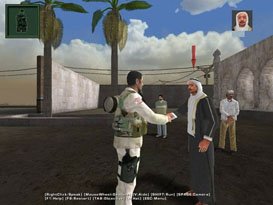
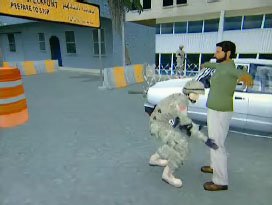
You've probably heard of Massively Multiplayer Online Games like EverQuest and World of Warcraft. There's also a smaller market for MMOGs that don't center around violence. I interviewed at one such company a couple of years ago, called There. (Yes, it led to many "Where?" "There." "Where?" "There." jokes. :P) They don't seem to have done as well as Second Life, possibly because Second Life actually allows users to write their own scripts to introduce new behaviors into the game. (Though I think it's more likely due to the fact that they didn't hire me. ;) j/k )
Anyway, There eventually announced that they got a military contract to adapt their game for military training. This I found really interesting. Eventually, that became the focus of the company, which then changed its name to Forterra Systems. The old There product languished and eventually spun off into its own company. Forterra has a couple of interesting videos on their site: Company Video and Defense Video.
Now, using computer games for military training is nothing new. I think the military's even used modified versions of Quake for training. There are two new things here: (1) many people from all around the world can participate in a single simulation, including off-duty soldiers, and (2) in addition to combat tactics training, their software also has a focus on the non-violent and cultural interaction that are big parts of our deployment in Iraq today.
On that second front, I recently saw this Wired article titled, Troops Learn to Not Offend. A company called Tactical Language Training, spun off from USC research, is writing computer games to teach soldiers nonverbal cues and cultural taboos. From the article:
In somewhat news, I randomly heard on Live 105 a mention of mydeathspace.com. " Only three things are certain in life. MySpace, Taxes, and Death. If you have a MySpace account and you die, this is where you will end up." Disturbing! The directory summarizes reasons for death, and most are because of car accidents, unsurprisingly. The relatedness? There are a few entries where the reason is listed as "Iraq": Sgt. Akers killed by an IED, Lance Cpl. Modeen and Sgt. Stevens killed by an IED, and Sgt. Jakoniuk killed by "Non-Combat Related Injuries". (He was a Blackhawk crewman, so presumably it was some sort of helicopter accident.)
You can click on their pictures to get to their old Myspace profiles. *shudder*
by ToastyKen
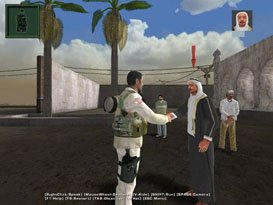
You've probably heard of Massively Multiplayer Online Games like EverQuest and World of Warcraft. There's also a smaller market for MMOGs that don't center around violence. I interviewed at one such company a couple of years ago, called There. (Yes, it led to many "Where?" "There." "Where?" "There." jokes. :P) They don't seem to have done as well as Second Life, possibly because Second Life actually allows users to write their own scripts to introduce new behaviors into the game. (Though I think it's more likely due to the fact that they didn't hire me. ;) j/k )
Anyway, There eventually announced that they got a military contract to adapt their game for military training. This I found really interesting. Eventually, that became the focus of the company, which then changed its name to Forterra Systems. The old There product languished and eventually spun off into its own company. Forterra has a couple of interesting videos on their site: Company Video and Defense Video.
Now, using computer games for military training is nothing new. I think the military's even used modified versions of Quake for training. There are two new things here: (1) many people from all around the world can participate in a single simulation, including off-duty soldiers, and (2) in addition to combat tactics training, their software also has a focus on the non-violent and cultural interaction that are big parts of our deployment in Iraq today.
On that second front, I recently saw this Wired article titled, Troops Learn to Not Offend. A company called Tactical Language Training, spun off from USC research, is writing computer games to teach soldiers nonverbal cues and cultural taboos. From the article:
Ironically, although the game was developed for the military, it contains no weapons or combat situations. It emulates a civil affairs mission and develops like a multipart story in which soldiers must gain the trust of the people they interact with in order to rebuild communities. "I got a kick out of removing the weapons and replacing them with gestures," Vilhjalmsson says.I'm glad, too, that the military is spending at least some fraction of its research budget on cutting edge technology that actually tries to reduce violence. :)
In somewhat news, I randomly heard on Live 105 a mention of mydeathspace.com. " Only three things are certain in life. MySpace, Taxes, and Death. If you have a MySpace account and you die, this is where you will end up." Disturbing! The directory summarizes reasons for death, and most are because of car accidents, unsurprisingly. The relatedness? There are a few entries where the reason is listed as "Iraq": Sgt. Akers killed by an IED, Lance Cpl. Modeen and Sgt. Stevens killed by an IED, and Sgt. Jakoniuk killed by "Non-Combat Related Injuries". (He was a Blackhawk crewman, so presumably it was some sort of helicopter accident.)
You can click on their pictures to get to their old Myspace profiles. *shudder*
Tuesday, April 18, 2006
Happy Survival Day, Homeland Mine
100 Years today ago the city I'm in shook and burned, and the region as a whole went through a lot of shock and trauma, but it survived. Here's to survival.
Be prepared, and help your community prepare.
100 Years today ago the city I'm in shook and burned, and the region as a whole went through a lot of shock and trauma, but it survived. Here's to survival.
Be prepared, and help your community prepare.
Monday, April 17, 2006
Pigs now fly, planes now don't
by ToastyKen
Patrick Moore, a founding member of Greenpeace, has written a WaPo article advocating nuclear power.
In related news, some Chicago company is turning Lear Jets into Limos:
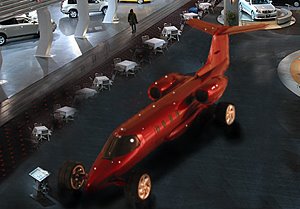
That appears to be a CGI mockup. Here's what the real thing looks like so far.
by ToastyKen
Patrick Moore, a founding member of Greenpeace, has written a WaPo article advocating nuclear power.
In related news, some Chicago company is turning Lear Jets into Limos:
That appears to be a CGI mockup. Here's what the real thing looks like so far.
Thursday, April 13, 2006
Google Calendar
I'm not sure what I think of the new calendar.google.com. Admittedly by its very nature it's impossible to evaluate in a day--you have to see how it performs over an extended period of time. But the sharing of calendars immediatley strikes me as a bad idea--do I really want to know what friend-so-and-so thinks is a better thing to do than hang out with me? How many times Miss X does laundry? When Buddy Joe Smith is going to his dermatologist? Do I want them to know about my movie watching habits? What a weird concept.
I'm not sure what I think of the new calendar.google.com. Admittedly by its very nature it's impossible to evaluate in a day--you have to see how it performs over an extended period of time. But the sharing of calendars immediatley strikes me as a bad idea--do I really want to know what friend-so-and-so thinks is a better thing to do than hang out with me? How many times Miss X does laundry? When Buddy Joe Smith is going to his dermatologist? Do I want them to know about my movie watching habits? What a weird concept.
Tuesday, April 11, 2006
That's So Cool!
I'm still bouncy and grinning because on the way to work this morning I saw the neatest combination of cool, geeky, cute, and good--a Brompton folding bike. This lady just wheeled it over the escalator, went up with me while she told me how it worked, unfolded it, and biked away. Totally worth the trans-Atlantic, trans-continental shipping costs!!
I'm still bouncy and grinning because on the way to work this morning I saw the neatest combination of cool, geeky, cute, and good--a Brompton folding bike. This lady just wheeled it over the escalator, went up with me while she told me how it worked, unfolded it, and biked away. Totally worth the trans-Atlantic, trans-continental shipping costs!!
Saturday, April 08, 2006
Le Sigh
I'm a bit worn out. I've been firing off black humored emails to my friends with rants and vignettes like this:
Person, tidying up a hospital room, holds up small bottle: Is this bottle something we should take home? What do we do with it?
Saheli: Well, what does the label say?
Person: It says, "All kinds of dangerous."
And calling them up late at night with inane requests for advice because I can't think straight. C'est la vie. Somehow, we have to make sense of it and do the best we can. Ah well, please be patient.
Anyway, you'll note that I have added a blogbadge to the right-hand sidebar:it's a link to a CIVIC/GiveMeaning campaign to raise money for medical care for two Iraqi women, Manal & Aliyah, who are civilian collateral damage from our little adventure there. I'm afraid I can't compose an eloquent appeal beyond asking you to read their stories. The director of the campaign emailed me personally to ask for help, and I cringed when I saw that the day they'd been shot by American troops in a checkpoint misunderstanding had been my birthday.
Anyway, below the fold, find some thoughts on the 62+ comment thread about Petroleum and Breakfast.
Continue Reading Here.
First, to the main point at hand--how can we better engineer our consumption to be more sustainable?
I think a lot of this discussion is being skewed by our not being practiced at holding multiple causes in our heads. In particle physics we would always talk about modes of decay--multiple phenomena could lead to the final event recorded in our detector, and our job in analysis was very often to tease out how much of the signal was due to cause A, how much to cause B, cause C, etc.. If the interactions of the tiniest particles can have so many components, much more complex phenomena, like ecology and behavior, almost certainly do. I don't want to *demonize* anything, but sprawl AND highways AND inefficient vehicles (AND computers AND agricultural subsidies AND. . .etc..) are all to blame in various amounts. My original plaintive request--for a little "engineering"--was essentially a request for some hardheaded tools of analysis for teasing apart these modes of destruction, figuring out where there was leverage and how an individual can figure out how their life interacts with those points of leverage, and how they can best exert the personal energy and resources they have to devote to the cause in the most optimal way. That's what I mean by engineering, not building a better car or better solar cell. Engineering as the systematic, quantitative solving of problems.
Rishi wrote: Echan brings up a great point, which is when you start to question any particular energy expenditure, the cost / benefit value of the use versus the environmental cost (assuming we value the environment very highly) seems to make any activity wasteful. . . My point is not mass suicide, of course, but to point out that when you start to think of any action on a micro level, including your drive to the store, or eating your bowl of cereal in the morning, you are never going to find an environmentally efficient one. It is only on the macro level that these questions even make sense.
This is true, but its truth shows that I did not express my original quest very well. Reductionism is always dangerous if you don't keep the big picture in mind. But reductionism is a tool for holding the big picture in your mind in the first place. It can't be dismissed out of hand. Spherical cows are also absurd, but they can still be useful.
Michael brought up the footprint calculator, which was actually sent to me by Peter during the initial conversation that led to the blogpost. I agree with TK that equal sharing of all resources is a useless and unnecessary thing to strive for--some poeple don't even want to have the what would be their equal share of the whole, and what you work for has to be taken into account somewhere--but I disagree with him that this makes the footprint calculator fallacious. Even if we were the average world consumers, the equality assumption in the calculator would be a good metric of how sustainable our consumption was. As it is, we are almost certainly at the high end of consumption. Our high demand is driving up the price for everyone so that some people can't even surive. Also, as Michael replied, we already have the 6 billion people. Even rapidly declining birthrates isn't going to decrease that number without equally drastic amounts of death and suffering. I'd like to find some other way.
When you actually think about the mechanics of the problem, it mostly has to do with things like habit, convenience, and imperfect information. So I'm actually interested in building practical tools. I'm thinking of actual calculators, software for a cellphone, notebook templates and worksheets for keeping track of purchasing choices, 12-step programs, diets, something--to make for better habits and routines. There's a lot of hyperbole about going on a "shopping diet," but it's actually a powerful analogy if you're willing to get beyond faddish advice. For example, I've lately had to think a lot about how to construct a very specific diet for someone with a lot of health issues. What was before a casual, effortless thing--eat three times a day, what you mostly feel like, trying not to make it too horribly unhealthful--has now turned into a carefully recorded and planned excercise in adding up calories, grams of protein and percentages of potassium, and balancing that against palatability and ease of preparation. When someone is healthy, anything goes. When someone is sick, you have to engineer their diet. Our planet is sick.
Finally, I'm not going to contort myself into philsophical knots trying to defend my desire to make sure the environment isn't irreparably damaged and the planet lasts for a good long while, despite the eventual heat death of the universe. Of course we have to balance that with other concerns--but we're wasiting time in doing that complex balancing act if we're still arguing about the validity of the concern. I just assumet that it is a valid concern. Conversations have to have some basic assumptions and that's mine. :-p
And I'm tired, so I'll talk about more meta-matters of social activism, capitalism, and the like later.
I'm a bit worn out. I've been firing off black humored emails to my friends with rants and vignettes like this:
Person, tidying up a hospital room, holds up small bottle: Is this bottle something we should take home? What do we do with it?
Saheli: Well, what does the label say?
Person: It says, "All kinds of dangerous."
And calling them up late at night with inane requests for advice because I can't think straight. C'est la vie. Somehow, we have to make sense of it and do the best we can. Ah well, please be patient.
Anyway, you'll note that I have added a blogbadge to the right-hand sidebar:it's a link to a CIVIC/GiveMeaning campaign to raise money for medical care for two Iraqi women, Manal & Aliyah, who are civilian collateral damage from our little adventure there. I'm afraid I can't compose an eloquent appeal beyond asking you to read their stories. The director of the campaign emailed me personally to ask for help, and I cringed when I saw that the day they'd been shot by American troops in a checkpoint misunderstanding had been my birthday.
Anyway, below the fold, find some thoughts on the 62+ comment thread about Petroleum and Breakfast.
Continue Reading Here.
First, to the main point at hand--how can we better engineer our consumption to be more sustainable?
I think a lot of this discussion is being skewed by our not being practiced at holding multiple causes in our heads. In particle physics we would always talk about modes of decay--multiple phenomena could lead to the final event recorded in our detector, and our job in analysis was very often to tease out how much of the signal was due to cause A, how much to cause B, cause C, etc.. If the interactions of the tiniest particles can have so many components, much more complex phenomena, like ecology and behavior, almost certainly do. I don't want to *demonize* anything, but sprawl AND highways AND inefficient vehicles (AND computers AND agricultural subsidies AND. . .etc..) are all to blame in various amounts. My original plaintive request--for a little "engineering"--was essentially a request for some hardheaded tools of analysis for teasing apart these modes of destruction, figuring out where there was leverage and how an individual can figure out how their life interacts with those points of leverage, and how they can best exert the personal energy and resources they have to devote to the cause in the most optimal way. That's what I mean by engineering, not building a better car or better solar cell. Engineering as the systematic, quantitative solving of problems.
Rishi wrote: Echan brings up a great point, which is when you start to question any particular energy expenditure, the cost / benefit value of the use versus the environmental cost (assuming we value the environment very highly) seems to make any activity wasteful. . . My point is not mass suicide, of course, but to point out that when you start to think of any action on a micro level, including your drive to the store, or eating your bowl of cereal in the morning, you are never going to find an environmentally efficient one. It is only on the macro level that these questions even make sense.
This is true, but its truth shows that I did not express my original quest very well. Reductionism is always dangerous if you don't keep the big picture in mind. But reductionism is a tool for holding the big picture in your mind in the first place. It can't be dismissed out of hand. Spherical cows are also absurd, but they can still be useful.
Michael brought up the footprint calculator, which was actually sent to me by Peter during the initial conversation that led to the blogpost. I agree with TK that equal sharing of all resources is a useless and unnecessary thing to strive for--some poeple don't even want to have the what would be their equal share of the whole, and what you work for has to be taken into account somewhere--but I disagree with him that this makes the footprint calculator fallacious. Even if we were the average world consumers, the equality assumption in the calculator would be a good metric of how sustainable our consumption was. As it is, we are almost certainly at the high end of consumption. Our high demand is driving up the price for everyone so that some people can't even surive. Also, as Michael replied, we already have the 6 billion people. Even rapidly declining birthrates isn't going to decrease that number without equally drastic amounts of death and suffering. I'd like to find some other way.
When you actually think about the mechanics of the problem, it mostly has to do with things like habit, convenience, and imperfect information. So I'm actually interested in building practical tools. I'm thinking of actual calculators, software for a cellphone, notebook templates and worksheets for keeping track of purchasing choices, 12-step programs, diets, something--to make for better habits and routines. There's a lot of hyperbole about going on a "shopping diet," but it's actually a powerful analogy if you're willing to get beyond faddish advice. For example, I've lately had to think a lot about how to construct a very specific diet for someone with a lot of health issues. What was before a casual, effortless thing--eat three times a day, what you mostly feel like, trying not to make it too horribly unhealthful--has now turned into a carefully recorded and planned excercise in adding up calories, grams of protein and percentages of potassium, and balancing that against palatability and ease of preparation. When someone is healthy, anything goes. When someone is sick, you have to engineer their diet. Our planet is sick.
Finally, I'm not going to contort myself into philsophical knots trying to defend my desire to make sure the environment isn't irreparably damaged and the planet lasts for a good long while, despite the eventual heat death of the universe. Of course we have to balance that with other concerns--but we're wasiting time in doing that complex balancing act if we're still arguing about the validity of the concern. I just assumet that it is a valid concern. Conversations have to have some basic assumptions and that's mine. :-p
And I'm tired, so I'll talk about more meta-matters of social activism, capitalism, and the like later.
Thursday, April 06, 2006
Four Things I Wish To Make Known
1. I really like the discussion going on in the post about petroleum and breakfast, despite its cantakerousness, and I hope it continues.
2. I have a lot of things to say about it.
3. I'm horribly painfully busy and cannot yet organize my thoughts on the subject. So please keep it up without me.
4. This video, courtesy of Apostropher at Unfogged, is simply one of the most wonderful web videos I have ever seen*. (I've linked directly to the video, but Apo's intro's funny too.) If you want snarky commentary and interpretation (gay, hot, sexy, whatever--these things are not my concern) Unfogged can do that much better than I can. All I can say is that I was having a no-good, very bad, quite awful day, and this thing made me laugh--appreciatively!!!--so hard that I dropped the keyboard and almost fell off the chair.
*The closest competitor that comes to mind is Matt is Dancing Around the World. In case you haven't noticed, I have a weak spot for dancing.
1. I really like the discussion going on in the post about petroleum and breakfast, despite its cantakerousness, and I hope it continues.
2. I have a lot of things to say about it.
3. I'm horribly painfully busy and cannot yet organize my thoughts on the subject. So please keep it up without me.
4. This video, courtesy of Apostropher at Unfogged, is simply one of the most wonderful web videos I have ever seen*. (I've linked directly to the video, but Apo's intro's funny too.) If you want snarky commentary and interpretation (gay, hot, sexy, whatever--these things are not my concern) Unfogged can do that much better than I can. All I can say is that I was having a no-good, very bad, quite awful day, and this thing made me laugh--appreciatively!!!--so hard that I dropped the keyboard and almost fell off the chair.
*The closest competitor that comes to mind is Matt is Dancing Around the World. In case you haven't noticed, I have a weak spot for dancing.
Friday, March 31, 2006
The Petroleum in Your Breakfast and the Carbon Dioxide Coming out of Your Shoes
Peter Slote, my first Aikido instructor and Oakland Recycling Specialist, kindly chastised me recently for even hoping that some recycled/recyclable plastic razors and tooth brushes were particularly environmentally friendly, pointing out that shipping to their east coast home and back alone consumed enough oil to be problematic. (On the other hand, I bet the normal ones are mostly shipped from China.) He just sent me a great article from today's Chronicle analyzing the fuel that went into transporting a simple, cheap, organic San Francisco breakfast to San Francisco.
There was a great (if annoyingly New York centric) article in Slate a couple weeks ago about the dark side of organic produce at places like Whole Foods---if your only concern is the environment (and not your probably non-threatened health or the health of the farm workers), you are over all better off buying local conventional produce than Chilean organic produce. (I was gratified because the day before this article came out I had picked my way through Whole Foods in Berkeley, carefully reading labels to pick up local cheese and crackers, but I was amused because most organic-supplying stores like Whole Foods label their produce adaquately enough for the consumer to make that choice and in the Western United States organic very often is as local as its going to get.)
Recently on Snarkmarket I left a somewhat snarky comment calling for a little browser plugin that would inform you how much the online purchase you just made would cost the atmosphere in carbon emissions to be shipped to your house. I later pointed out to Robin, climateboy, and Saurabh by email that this would be unfair, because the exact same problems apply to most "local" traditional stores, and Robin got the same feedback over at WorldChanging. In fact, shipping and handling may very well be more efficient than individual consumer driving.
I've been thinking about locality ever since last fall, when I went to the Peak Oil talk where I first met up with Hedgehog. For example, we have noticed that it is almost impossible to buy a solid pair of local shoes. Scotto is fond of pointing out that we basically take oil and turn it into food. Take a look at the Chad Heeter article Peter sent me:
pointed reminders that the best way to reduce our dependence on oil and save the atmosphere is to reduce consumption. (They're surprisingly effective reminders--small but spiny mammals land memorable punches)
I've been trying to drive less--and trying to come up with a palatable caffeine source that can get me to the closer parking lot without itself getting here from half way around the world. I've been very, very, very slowly working on becoming a competent biker with a lot of help from my friends. I've also been paying more attention to what I buy and where it comes from, and trying to cut down on non-local purchases. I'm not as enthused about having such a globetrotting 2006 as 2005 was. But it's all very slow and haphazard. It hardly seems optimal. I want to engineer something better, precise.
So, what do we do? Speak up, dear readers. I am at a loss. Really, we all are.
Peter Slote, my first Aikido instructor and Oakland Recycling Specialist, kindly chastised me recently for even hoping that some recycled/recyclable plastic razors and tooth brushes were particularly environmentally friendly, pointing out that shipping to their east coast home and back alone consumed enough oil to be problematic. (On the other hand, I bet the normal ones are mostly shipped from China.) He just sent me a great article from today's Chronicle analyzing the fuel that went into transporting a simple, cheap, organic San Francisco breakfast to San Francisco.
There was a great (if annoyingly New York centric) article in Slate a couple weeks ago about the dark side of organic produce at places like Whole Foods---if your only concern is the environment (and not your probably non-threatened health or the health of the farm workers), you are over all better off buying local conventional produce than Chilean organic produce. (I was gratified because the day before this article came out I had picked my way through Whole Foods in Berkeley, carefully reading labels to pick up local cheese and crackers, but I was amused because most organic-supplying stores like Whole Foods label their produce adaquately enough for the consumer to make that choice and in the Western United States organic very often is as local as its going to get.)
Recently on Snarkmarket I left a somewhat snarky comment calling for a little browser plugin that would inform you how much the online purchase you just made would cost the atmosphere in carbon emissions to be shipped to your house. I later pointed out to Robin, climateboy, and Saurabh by email that this would be unfair, because the exact same problems apply to most "local" traditional stores, and Robin got the same feedback over at WorldChanging. In fact, shipping and handling may very well be more efficient than individual consumer driving.
I've been thinking about locality ever since last fall, when I went to the Peak Oil talk where I first met up with Hedgehog. For example, we have noticed that it is almost impossible to buy a solid pair of local shoes. Scotto is fond of pointing out that we basically take oil and turn it into food. Take a look at the Chad Heeter article Peter sent me:
What they've discovered is astonishing. According to researchers at the University of Michigan's Center for Sustainable Agriculture, an average of more than 7 calories of fossil fuel is burned up for every calorie of energy we get from our food. This means that in eating my 400-calorie breakfast, I will, in effect, have consumed 2,800 calories of fossil fuel energy. (Some researchers claim the ratio is as high as 10 to 1.)It is, actually, pretty easy for me to mostly eat local food, because of where I live. Normally, my staple is basmati rice, and that, of course is shipped from India, but I have been eating less of that lately, and I know that almost everything else I eat is from Northern California, or at least packaged here. But the real problem here is an information problem. The oh-so-glorious free market is supposed to work when all the players are fully informed about all the risks and consequences of their choices. Besides their being ludicrous assumptions about how fast information can travel in time in that model, there are ludicrous assumptions about how much the information there even exists for the consumer to process. Heeter writes:
But if there was truth in packaging, where my oatmeal box now tells me how many calories I get from each serving, it would also tell me how many calories of fossil fuels went into the product.In light of Colin's excellent recent post on James Woolsey's recommendation for avoiding foreign oil consumption, let me point out that this isn't just about foreign policy or even peak oil. This is about the fact that we are in a hell of a lot of trouble. See this week's Time cover -- our planet is melting. All the burning Turkey offal in the world may save us from more wars (though I doubt it) but it won't save our atmosphere. Hedgehog likes to give us
I've been trying to drive less--and trying to come up with a palatable caffeine source that can get me to the closer parking lot without itself getting here from half way around the world. I've been very, very, very slowly working on becoming a competent biker with a lot of help from my friends. I've also been paying more attention to what I buy and where it comes from, and trying to cut down on non-local purchases. I'm not as enthused about having such a globetrotting 2006 as 2005 was. But it's all very slow and haphazard. It hardly seems optimal. I want to engineer something better, precise.
So, what do we do? Speak up, dear readers. I am at a loss. Really, we all are.
Subscribe to:
Posts (Atom)